
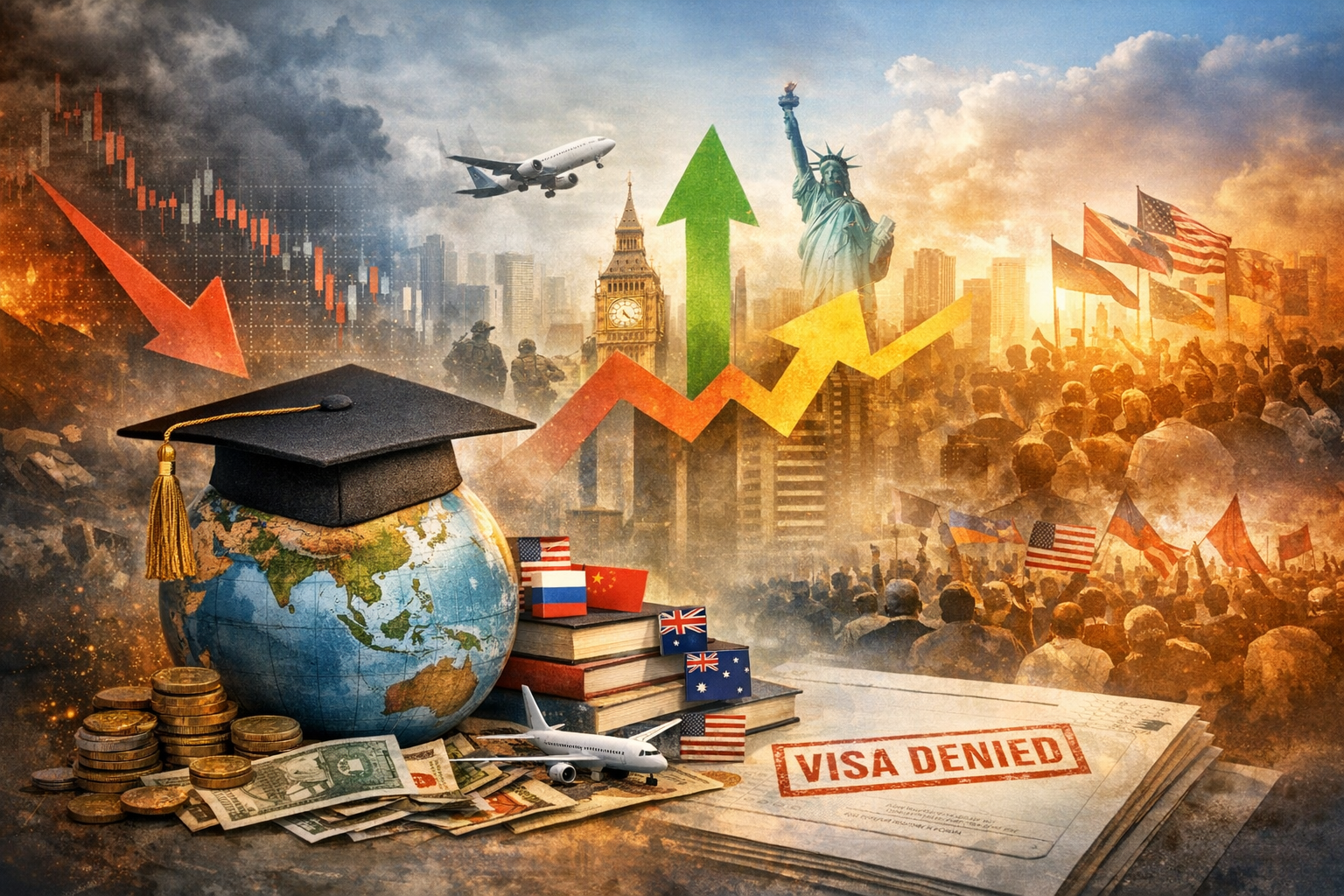
International Education After Certainty
Why the Pressure Is Structural, the Panic Is Wrong, and Waiting Is Not a Strategy
Why This Article Exists
International education is often discussed through cycles: boom years, downturns, recovery years, and resets. Many people believe we are simply in another difficult phase, one that will ease once inflation cools, politics stabilize, and global conditions normalize.
This article exists to explain why that framing no longer works.
What international education is experiencing today is not a temporary disruption, but a structural shift in how mobility, affordability, and policy interact. The sector is not collapsing, but it is operating under constraints that did not exist at this scale before.
This is not an article about numbers, forecasts, or annual comparisons. It is about why decisions feel harder, why waiting feels riskier, and why returning to “normal” is no longer a strategy.
The World Did Not Suddenly Become Unstable
It is easy to point to recent events and conclude that today’s pressure is an abnormal spike. That conclusion misses the deeper change.
For decades, international education expanded inside a system that assumed governments would facilitate mobility, housing markets would absorb growth, affordability could be managed through volume, and policy direction would be broadly predictable.
That system rewarded optimism and scale.
What has changed is not instability itself, but the tolerance for risk within public systems. Governments, families, and institutions now act defensively by default. That shift does not reverse simply because conditions improve.
A Personal Observation About What Changed in the World
Between 2007 and 2011, I travelled frequently to East Asia, including Japan, Korea, and China. At the time, Japan felt unquestionably modern, Korea dynamic and fast rising, and China visibly behind. Bicycles dominated the streets, traffic discipline was weak, pollution was heavy, and prosperity felt uneven.
When I returned to China in 2019, after an eight year gap, the contrast was striking.
Infrastructure had transformed at a pace few societies have ever achieved. Cities were cleaner, transportation disciplined, air quality visibly improved, consumption patterns diversified, and confidence, quiet rather than loud, was everywhere. What impressed me most was not wealth, but continuity. There was a sense that the country knew where it was going and was executing toward it.
When I asked Chinese friends how they felt about China becoming a leading global power, most did not react with pride or triumph. They barely framed it that way. Life felt more orderly, more predictable, less anxious. Power, to them, was not a slogan. It was background stability.
This experience matters because it mirrors how power actually works. Power is not felt most strongly by those who possess it, but by those who must navigate its consequences.
Why Politics and Economic Credibility Now Matter Differently
At the same time that countries like China were demonstrating continuity, Western leadership, particularly that of the United States, was becoming increasingly inconsistent.
Agreements signed under one administration were discarded by the next. Foreign policy swung dramatically every four years. Allies learned that commitments were conditional, reversible, and often transactional.
This inconsistency did more damage than any single policy decision. Trust eroded.
Global perception matters as much as legal frameworks. When the Israeli prime minister is welcomed across capitals while the Venezuelan president is forcibly seized, many countries do not read nuance. They read double standards. When threats replace diplomacy and power appears selective rather than principled, leadership loses moral gravity.
This is not an anti American argument. It is an observation about how the world reacts to unpredictability and perceived injustice.
And when leadership credibility weakens, others do not need to persuade the world to follow them. The world simply begins to hedge.
Risk, Affordability, and the End of Automatic Assumptions
Economic pressure today is not defined by a single crisis or political episode. It is defined by fragility.
Even when inflation eases, the aftereffects remain: higher baseline costs, tighter household budgets, and greater sensitivity to risk. Studying abroad is no longer framed as a default life step. It is evaluated as a high stakes financial decision with limited margin for error.
Housing shortages in major destination countries have turned international education into a domestic policy issue. The predictable response is not expansion, but management: intake caps, prioritization, and conditional access.
These measures may ease, but the assumption of unlimited capacity is gone.
International education can still grow, but only within constraints that now shape policy, pricing, and perception simultaneously.
This is not cyclical discomfort. It is a repricing of risk.
The End of the Old Globalisation Promise
The globalization era that shaped international education assumed something essential. Exposure to Western systems would naturally align values, behaviour, and political outlook.
International education was a cultural glue. Students travelled abroad to learn, absorb norms, and return home as informal ambassadors of a shared global future.
That assumption no longer holds.
The world is no longer converging. It is fragmenting, realigning, and recalibrating power. Economic integration continues, but ideological unity does not. Trade persists, but trust is conditional.
In this environment, international education does not disappear, but its role changes fundamentally.
It is no longer about uniting the world. It is about preparing individuals to operate inside a complex, unequal, and politically charged global reality.
Why Waiting Is Not a Neutral Choice
Many institutions believe the safest move is to hold steady until conditions improve. This belief rests on an assumption: that the environment will revert to what it was.
That assumption is now the risk.
Waiting is not passive. It locks institutions into fixed cost structures, outdated geographic exposure, fragile margins, and dependency on volume.
When conditions do improve, those who adjusted early are already positioned. Those who waited are still exposed.
This Is Not Decline, It Is Differentiation
International education is not shrinking. Demand remains real.
What is changing is who can operate comfortably under constraint.
Systems built purely on scale struggle first. Systems built on clarity of role, diversified exposure, and controlled growth adapt faster.
Some institutions should downsize. Some should hold. Some should expand into parallel destinations or new functions.
There is no universal answer. But there is a universal requirement: intentionality.
Where Agents Stand in This Shift
Agents experience this transition before institutions do. They absorb currency swings, parental hesitation, visa uncertainty, and policy backlash.
As pressure increases, agents’ value shifts from volume delivery to judgment, alignment, and trust management.
This is not a reduction of importance. It is a redefinition.
Agents who understand structural constraints will remain central. Those who rely on old assumptions will struggle alongside the institutions they represent.
Final Reflection
Life may feel good for some. Conditions may improve. Inflation may cool. Leadership may change.
None of that restores the old assumptions.
International education is entering a phase where stability is managed, not assumed, growth is intentional, not automatic, and resilience comes from structure, not scale.
This is not a warning. It is a recalibration.
Those who understand it will not panic. Those who ignore it will not fail immediately. But over time, the difference will become obvious.

You may also like
المغرب والسنغال: عندما تتصدّع القيادة تحت الضغط